


Saori weaving makes me very happy! To sit at a beautifully designed loom, to get into flow with colour and texture with no pressure, just creative outlet, is such a privilege. But what to do with the cloth? I have got some seriously beautiful cloth waiting to find its purpose. Cue a newsletter from Rosie Green at Saorimor Saori studio in Bangor advertising a Yarn to Garment workshop. I had to sign up.
One of the wonderful innovations that have come from Saori HQ in Japan is the prewound warp. These, as the name suggests, are warps that are wound and ready to thread through the heddles and the reed. They enable you to get weaving without delay and without lots of costly and space-eating warping equipment. Most of the prewound warps are black and come in either cotton or wool. The black warp threads allow the colours of the weft to really shine and simplify the colour decision making process. I have been using prewound warps since I got my loom so it was time to make my own warps. This would enable me to take full control of my Saori weaving projects. Rosie’s workshop was going to teach me to wind warps and get me confident enough to cut my cloth.
Day One
On the first day Rosie showed me two different techniques for making warps.
The first method enables you to make what is essentially a prewound warp. I made the warp on the Saori warping frame holding five threads at once. Then used the tabletop beaming and threading holder with the cross holder to sley the reed, thread the heddles and wind the warp onto a tube. This method allows you to basically make your own prewound warps, so you could store them safely for later use. I was so excited to be there at this point that I forgot to take photos. I did pull myself together eventually, so I have some pictures to share of the second warping process. The second method was what I imagine would be considered the traditional method where you make a warp that is wound onto the loom from the front, through the reed and heddles to the back.
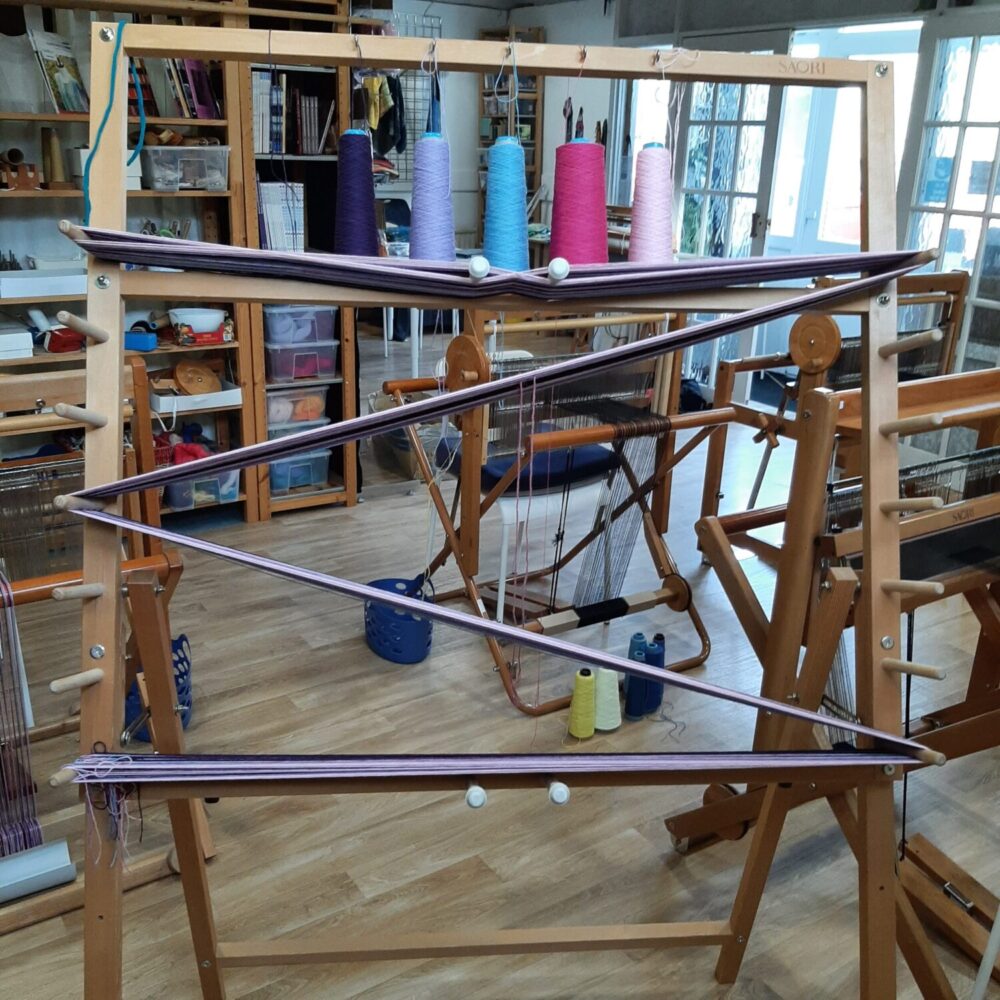
My warp on the Saori warping frame.
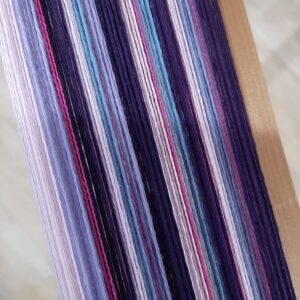
A close up of my warp.
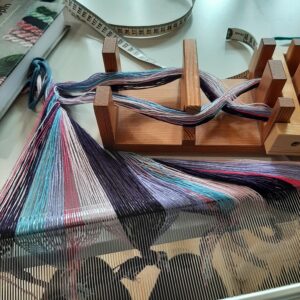
The warp on the cross holder while I sley the reed.
Day Two
The second day was spent getting my warp onto the loom and weaving a length of cloth. I used the cross holder and the Saori Threading Holder so I could thread the heddles and sley the reed whilst sitting at a table rather than leaning over the loom. This is a much more comfortable way of working. These developments, which allow for wider accessibility to all aspects of the weaving process for those with compromised mobility or other physical constraints, are another aspect of the Saori way that I find attractive.

Threaded heddles in the Saori threading holder.
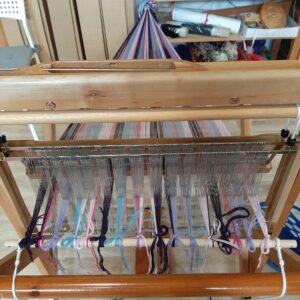
The warp threaded and tied, ready to be wound on.
The weaving was lovely. To be able to sit at the loom and weave and for there to be nothing else that I felt I could or should be doing, was wonderful. Weaving with Rosie’s gentle company, a bit of chat and advice when needed was such a treat.
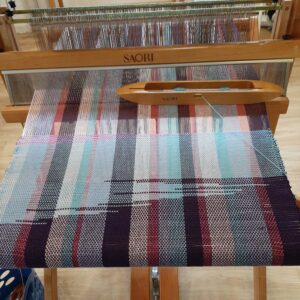
Enjoying the play of the colours in the weaving.
Day Three
On the third and final day I finished the weaving in the morning and we finished the cloth and set it to dry on a heated airer while we ate lunch and I browsed patterns. After lunch and with a pattern decision made, it was time to make decisions about how to position the cloth and where to make the neck hole.
Cutting the cloth was nerve wracking but Rosie was really encouraging and made sure that I had sewn a line of stitching to cut along so my cloth wouldn’t unravel. I have an uneasy relationship with the sewing machine, so the actual sewing was the most stressful part for me but having Rosie on hand to help and advise made it all go pretty smoothly. Though I didn’t quite finish my dress at the workshop, I have continued to work on it at home and I have to say that I am delighted.

Actually sewing!
I have learnt so much about how cloth works, having made a couple of warps. Also, I have realised how much I have to learn about how colour works in two dimensions, warp and weft. I have learnt how to use my sewing machine a bit more too and I have to say, I am really enjoying it. It is not as noisy as I thought it would be and I can set it to go slowly while I build confidence. Best of all, I can now start wearing my cloth. My clothes will be unique and possibly quite eccentric now. I intend to have a lot of fun making them from scratch!
Massive thanks to Rosie for her patience and for being so generous with her knowledge and experience.
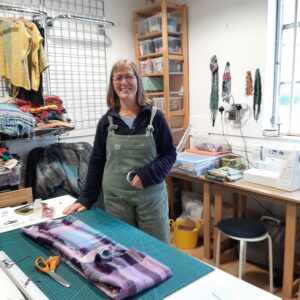
The lovely Rosie Green of Saorimor, Bangor.

Here I am, awkwardly modelling my handwoven dress.
While you wait for me to hone my sewing skills you can find my Saori weaving here in the Slow Fashion section of my shop. I add new scarves as I make them, so do check back every now and then.




Wonderful ❤️