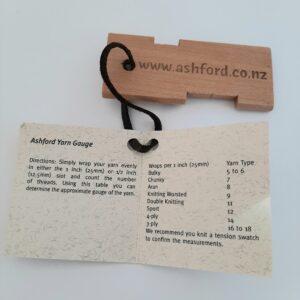
Wraps per inch, usually abbreviated to WPI, is a really useful way of measuring yarn. It allows you to compare different yarns and to compare your handspun against specific commercially spun yarns.
How Do I Measure Wraps Per Inch?
Although measuring wraps per inch is a very simple procedure, it does require a little bit of thought. I have this nifty little tool from Ashford which has an inch cut out on one side and a half inch cut out on the other side. This allows me to carefully wrap my yarn around until the inch (for thicker yarns) or the half inch (for fine yarns) is full.
When wrapping your yarn it is important to make sure that the yarn is not stretched or allowed to overlap. So hold your yarn without tension and wrap it around so each strand sits comfortably next to the previous wrap on the measure. Once you have filled the inch, count how many wraps you have and that is your wraps per inch. If you have used the half inch, count the wraps, multiply by two and that is your wraps per inch.
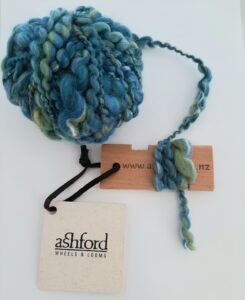
Polzeath Breeze beaded yarn being measured on the yarn gauge.
You don’t actually need a special tool, a ruler demarcated in inches will do. Use your thumb to hold the yarn in place while you wrap. It can be a little awkward and if it is, take a chunky wooden knitting needle and mark an inch from the thick end. The bobble on the end of the needle will help to hold the yarn in place as you wrap.
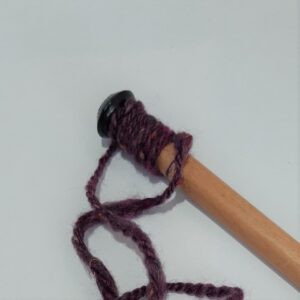
If you look closely you can see where I have marked the inch on the knitting needle.
Why Do I Need to Know the WPI?
If you are a hand spinner, or a user of handspun yarn, WPI can be very important. Knitting patterns are generally written for specific yarns. This means that when I find a pattern that I would like to knit, I look up the technical specifications of the recommended yarn and spin a yarn that has the same WPI. This is how I can be pretty certain that my knitted fabric will conform to the gauge of the pattern. There are, of course, other things to consider when substituting yarn for a pattern like fibre content or drape for example.
What Do the Different Wraps Per Inch Mean?
There are lots of charts available on the internet that will show you how the WPI number translates to yarn weights. My Ashford gauge comes with a handy guide attached to it, so that is my starting point when substituting yarn. I do also knit a swatch to check that the knitted fabric will work for the pattern I want to knit.